








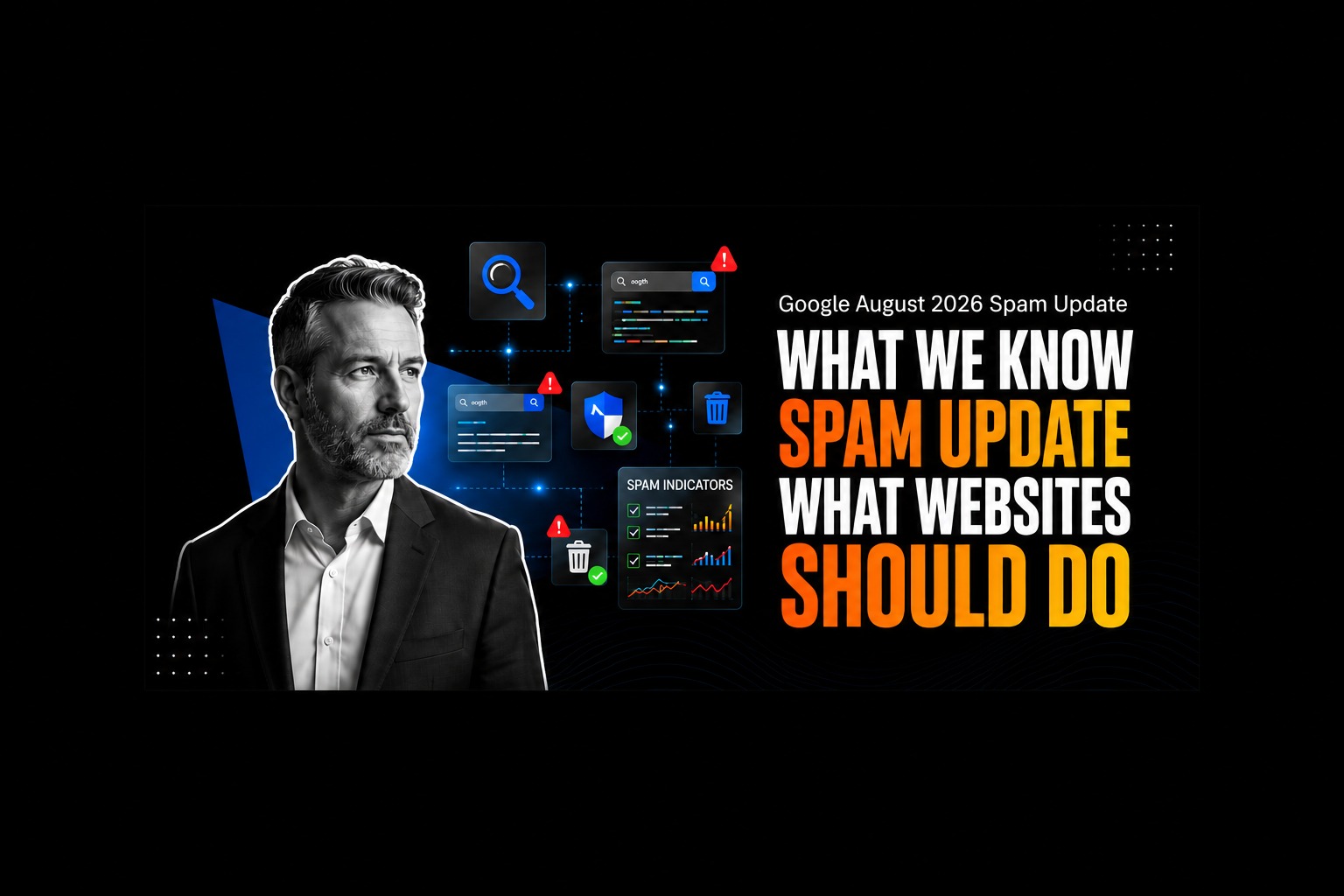
Google August 2026 Spam Update: What We Know So Far and What Websites Should Do
Google has started rolling out another spam update, and if you're responsible for a website's organic traffic, this is probably one of those updates you'll want to keep an eye on.
The Google August 2026 Spam Update started rolling out on August 18. Google says the update is global and applies to all languages. The rollout is expected to take a few days.
At the moment, though, there isn't a long list of new spam tactics from Google that SEOs can work through. Google hasn't said that this update is specifically about AI-generated content, backlinks, expired domains, or any other single SEO tactic.
That distinction is important.
There has already been plenty of speculation around the update, but speculation and confirmation are two different things. If your rankings moved after August 18, it doesn't automatically mean your website was hit by the spam update.
There are several other things that can move organic traffic around.
So, rather than jumping straight into recovery mode, it's worth taking a step back and looking at what Google has actually announced and what you should be checking on your own website.
What is the Google August 2026 Spam Update?
The August 2026 Spam Update is a Google Search spam update that began rolling out globally on August 18, 2026.
Google announced the rollout through its Search Status Dashboard. The update applies across languages and may take several days to finish.
This isn't a core update.
That's worth pointing out because the two are often mixed together whenever rankings start moving.
A core update generally involves broader changes to Google's ranking systems. A spam update is more specifically concerned with identifying and handling websites or practices that violate Google's spam policies.
Google hasn't announced a new spam policy alongside the August update.
So, for now, the sensible approach is to look at the spam policies that already exist rather than trying to guess what secret change Google may have made.
When did the August spam update start?
The rollout began on August 18, 2026.
Google's Search Status Dashboard recorded the start of the incident at around 9:27 a.m. Pacific Time. Google also noted that the rollout could take a few days to complete.
This creates an important problem for anyone looking at their analytics today.
If you see traffic falling on August 18 or August 19, you don't yet have enough information to confidently say:
"The August spam update caused this."
Search traffic doesn't behave that neatly.
A ranking can move because a competitor improved its page. Search demand can change. A technical issue can affect crawling. A SERP can change. AI features can affect clicks. And, of course, Google can make changes that aren't related to the spam update at all.
That's why I wouldn't recommend making major SEO decisions based on one or two days of data.
Is Google targeting AI-generated content with this update?
This is probably going to be one of the first questions clients ask.
The short answer is: Google hasn't said that the August 2026 Spam Update specifically targets AI-generated content.
That doesn't mean AI-generated content is completely outside Google's spam policies.
Google has already made its position on this fairly clear. Using AI or automation to produce content isn't automatically a violation. The problem comes when automation is used to produce large amounts of content primarily to manipulate search rankings, particularly when that content doesn't provide meaningful value to users.
Google refers to this as scaled content abuse in its spam documentation.
And this is where the conversation gets more interesting.
There is a big difference between:
"We used AI to help our writer research and structure an article."
and:
"We generated 2,000 pages targeting every possible keyword variation and published them without adding anything useful."
Those are not the same thing.
The tool isn't necessarily the problem. The way the content is produced and the value it provides are much more important.
So if your website uses AI as part of its content workflow, I wouldn't panic and start deleting AI-assisted content.
I'd start reviewing the quality of the pages instead.
What should you check if your rankings have dropped?
This is where I'd spend most of my time if I were auditing a site during the update.
Start with Google Search Console.
Look at your performance data from before August 18 and compare it with what happens during the rollout. Don't just look at total clicks. Look at impressions, average position, queries and individual landing pages.
One thing we regularly see during algorithm changes is that the overall traffic number doesn't tell the whole story.
For example, a website might lose 20% of its organic traffic, but the decline could actually come from three informational blog posts while its important service pages remain stable.
That's a very different situation from the entire domain losing visibility.
Look at the pages, not just the traffic graph
Export the pages that have experienced the biggest drops.
Then ask a fairly simple question:
What do these pages have in common?
Are they all blog articles?
Are they location pages?
Are they product pages?
Were they created using the same template?
Are they thin pages targeting very similar keywords?
Do they mostly repeat information already available elsewhere?
Finding a pattern is usually more useful than staring at the overall traffic graph.
Check for thin and repetitive content
One area I'd pay particular attention to is websites that have scaled their content aggressively.
This happens quite often.
A company starts with 20 good service pages. Organic traffic grows. Then someone decides they need 200 pages.
Suddenly there are pages for every city, every industry, every keyword variation and every possible combination of the two.
On paper, it looks like a much bigger website.
In reality, many of those pages may have very little to say.
For example, imagine an agency creates separate pages for:
- SEO Agency Mumbai
- SEO Agency Bangalore
- SEO Agency Delhi
- SEO Agency Pune
- SEO Agency Hyderabad
There's nothing inherently wrong with having location-specific pages.
The problem is when the five pages are essentially the same article with the city name changed.
A useful location page should actually give someone a reason to visit it.
Local examples, relevant projects, service information, FAQs, market context and genuinely useful information can make a difference.
Simply replacing "Mumbai" with "Bangalore" doesn't.
Don't ignore your website's UX
Spam updates are generally discussed as a content and SEO problem, but I wouldn't look at a website in isolation from its user experience.
A page can technically rank and still be a poor experience.
Think about pages filled with intrusive pop-ups, misleading buttons, aggressive redirects or other elements that make it difficult for people to do what they came to the site to do.
Google's spam documentation also covers deceptive practices, and Google has specifically discussed issues such as back button hijacking.
This is one reason SEO, development and UI/UX shouldn't operate as completely separate functions.
A search strategy can bring someone to the website.
The website still has to earn their trust once they arrive.
What about backlinks?
Backlinks are another area where people tend to panic during algorithm updates.
A website's rankings fall and suddenly everyone starts talking about "toxic backlinks."
I'd be careful with that.
Not every low-quality link pointing to your website is something you need to remove or disavow. Websites naturally accumulate links over time, including links that aren't particularly useful.
Instead of looking for a scary-looking backlink report, look for evidence of deliberate manipulation.
Was there a sudden campaign generating hundreds or thousands of obviously unnatural links?
Are there patterns that suggest automated link building?
Is there excessive use of exact-match commercial anchor text?
Were links purchased specifically to manipulate rankings?
Those questions are much more useful than simply counting how many "toxic" links a third-party tool has identified.
What about keyword stuffing?
Keyword stuffing is hardly a new SEO tactic, but it's still worth checking.
Sometimes it happens deliberately.
More often, it happens because content has been written with SEO metrics in mind rather than people.
You don't need to mention "SEO agency in Mumbai" fifteen times in a 1,000-word article to make Google understand what the page is about.
If a sentence sounds strange when you read it aloud, that's usually a good sign that the keyword has been forced into it.
Modern search is much better at understanding topics, entities and context than the old approach of repeating an exact phrase as many times as possible.
Write for the person first.
Then make sure the page is properly optimized.
Should you change your website right now?
Probably not — at least not dramatically.
This is one of the easiest mistakes to make during an algorithm update.
A website owner sees rankings fall and immediately starts:
- deleting pages
- changing titles
- rewriting every blog
- removing backlinks
- changing URLs
- publishing more content
- changing internal links
After a couple of weeks, the website looks completely different, but nobody knows which change actually helped.
I'd take a slower approach.
First, establish whether there really is a meaningful decline.
Then identify the affected pages.
Then look for patterns.
Only after that should you start making changes.
SEO isn't a reaction game.
Sometimes the best decision during a Google rollout is to collect more data.
A simple way to investigate a ranking drop
If we're looking at a website affected during a Google update, the process we'd typically follow is fairly straightforward.
First, establish a baseline.
Compare performance before the update with performance during the rollout.
Then identify the pages and queries that have moved.
After that, look at the type of content involved.
If only blog pages have dropped, the investigation will look different from a situation where commercial landing pages, category pages and the homepage have all declined.
Next comes the actual audit.
Look at content quality, internal linking, technical SEO, indexing, page experience, backlinks and the overall search intent of the affected pages.
And then there is an important final question:
Did competitors gain what you lost?
That's often overlooked.
A ranking decline isn't always about Google deciding your page is "bad."
Sometimes another page simply became more useful.
If three competitors have published substantially better resources over the past six months, the answer may not be fixing a spam issue at all.
It may be improving the page.
What does this mean for SEO in 2026?
This is probably the bigger conversation behind the August update.
Search has changed considerably.
Businesses aren't only competing for traditional organic rankings anymore. They also need to think about how their brand appears in AI-powered search experiences.
Google has been expanding AI features in Search, including AI Overviews and AI Mode. Google has also started introducing reporting around visibility from generative AI features in Search Console.
That doesn't mean traditional SEO is disappearing.
Quite the opposite.
Google's guidance for AI features still emphasizes many of the same fundamentals: pages need to be accessible, indexable, useful and compliant with Search policies.
The difference is that the search journey is becoming less linear.
Someone might discover your company through a traditional search result.
Someone else might encounter your brand in an AI-generated answer.
Another person might see your Instagram content, search your brand later and then visit your website.
The boundaries between SEO, content, social, UX and brand visibility are becoming less clear.
That's why we increasingly look at SEO alongside AEO and GEO, rather than treating them as completely separate strategies.
SEO, AEO and GEO: what should businesses actually focus on?
There is a lot of terminology around AI search right now, but the underlying idea is fairly simple.
SEO helps your website become discoverable and understandable in search engines.
AEO focuses more heavily on providing information that can be used to answer specific questions.
GEO looks at how your brand and content are represented across generative search experiences.
There is overlap between all three.
A website with poor technical SEO will struggle regardless of how good its AEO strategy is.
A website with technically perfect pages but weak, generic content isn't likely to become a trusted source either.
And a business with great content but a poor website experience is leaving part of the opportunity on the table.
The fundamentals still matter.
The difference is that we're now thinking about visibility across a much wider search ecosystem.
What should businesses do during the August 2026 update?
For most businesses, I'd keep it fairly simple.
Don't chase every theory you see on LinkedIn or SEO forums.
Keep monitoring Search Console.
Track the pages that matter commercially, not just the pages that generate the most impressions.
Review content that has clearly lost visibility.
Look at technical issues that could interfere with crawling or indexing.
Check whether your location or programmatic pages are genuinely useful.
Review your backlink profile if there is evidence of manipulative link building.
And if you've scaled AI-generated content heavily, take a proper look at whether those pages actually deserve to exist.
Most importantly, don't make ten changes at once.
Give yourself a way to understand cause and effect.
The bigger lesson from the August 2026 Spam Update
It's tempting to look at every Google update and ask:
"What do I need to change so Google doesn't penalize my website?"
I think that's the wrong mindset.
The better question is:
"If Google's systems become better at identifying low-value and manipulative websites, would our website still stand out?"
If the answer is yes, you're probably in a good position.
If the answer is no, the August update may simply be highlighting weaknesses that were already there.
That could mean thin content.
It could be an over-reliance on programmatic pages.
It could be a weak technical foundation.
It could be poor UX.
It could be an unnatural link profile.
Or it could simply be that competitors have built better resources.
The August 2026 Spam Update is still rolling out, so there is no reason to rush into conclusions yet. Google has not announced a new spam category specifically associated with this rollout.
For now, monitor the data, investigate the pages that move, and keep your focus on the fundamentals.
Good SEO isn't about trying to predict every algorithm change.
It's about building a website that remains useful when the algorithms change.
Final Takeaway
If your rankings have changed since August 18, don't panic.
Check the data first.
Find the pages that moved.
Look for patterns.
Audit the content and technical setup.
Then make changes based on evidence rather than assumptions.
And as search continues to evolve, don't limit the strategy to rankings alone. SEO, AEO, GEO, content, UX and the overall digital experience increasingly need to work together.
That's likely to matter much more in the long run than trying to reverse-engineer one particular Google update.
Source & Analysis: 3minds — a B2B digital marketing and branding agency offering SEO, UI/UX design, website development, paid marketing, social media, and AI search optimization.
Related Blogs

How AI Is Changing the Future of SEO Services in 2025
Artificial Intelligence is redefining how SEO works. From smarter keyword targeting and automated optimization to AI Overviews on platforms like ChatGPT, Gemini, and Perplexity — SEO in 2025 demands a blend of creativity and machine intelligence. Partnering with a forward-thinking SEO agency in India like 3minds ensures your business stays visible, relevant, and competitive in this new AI-driven landscape.

How Indian Packaging Design Services Are Addressing The Rise Of D2c Brands